February is probably the most frustrating month of the year for a gardener. The winter pictures we so carefully planned are now beginning to fall apart. Those upright stems, seed heads, our so-called winter silhouettes, have finally started to collapse following rain, snow or storms. We need to get out into the garden and start cutting the grasses and perennials back, but the weather needs to offer us a window of opportunity before we can begin this essential annual tidy up. Dry, sunny weather is needed when the stems of perennials will be brittle and can be easily broken off or cut down and removed. At the same time precocious bulbs, especially alliums, snowdrops and daffodils, will be growing up strongly which is why we need to clear the dead tops of adjacent perennials as soon as we can in order to be able to see and appreciate them. Eventually such days do arrive, but when?
The removal of the dead tops of perennials is the priority in February. I try to break or cut these into short lengths and drop them onto the soil around the crowns of the parent plants. They decompose slowly and help to nourish the soil in a natural manner and avoiding me having to make a trip to the compost heap.
Hellebores will come into flower this month, but if you haven’t already done it, cut back their old foliage. It will probably be damaged by fungal infection and by removing it the flowers will be shown to their full advantage.
Biennials such as Lunaria annua and Salvia sclarea self seed once established in a garden and by February will be starting into growth ready to flower in the coming spring or summer. Direct sowing is the easiest method, but sometimes I find it useful to grow these plants in pots and plant them out in late February in exactly the spots where I need them.
Whilst it might be difficult to get out and do some real gardening this month, there is no harm in dreaming. I finalise my seed ordering and make ready to sow some of the few annuals and perennials that benefit from an early sowing under protection. It is also a good time to start thinking about dividing any perennials in the borders as by now asters, phlox and even crocosmias will be thrusting into fresh new growth and the earlier you do this the longer they have to get going.
If roses and clematis have not been pruned last month, now is still a good time to do so.
Key Plants

Hellebores, snowdrops and winter aconites.
February is the time for snowdrop lunches in England where different species of Galanthus and their hundreds of cultivars are exchanged at exorbitant prices. In the garden their differences are hard to appreciate from a standing position. In my opinion, there is nothing wrong with the common Galanthus nivalis for forming wide flower carpets across any woodland floor. The larger growing species G. elwesii is bolder with coarser foliage and as a garden plant I actually prefer it. I use S. Arnott, a cultivar that is nowadays widely available and reasonably priced. Even after flowering its foliage makes effective ground cover before adjacent perennials rise up to take over the space.
Winter aconites, Eranthis hyemalis, are yellow and make the perfect accompaniment to snowdrops as do the winter-flowering, purple flowered Cyclamen coum. Beautiful carpet tapestries of these can be created with the odd clump of Helleborus rising up above them as discrete specimens.
It is still early for the majority of spring flowering bulbs, but there are early flowering forms and species of both Crocus and Narcissus to be aware of. Mice eat every crocus bulb I plant in my garden which is why I so delight in seeing such earlys’ as Crocus tommasinianus, C, flavus, C. sieberi and C. chrysanthus in other people’s gardens.

Narcissus ‘Rijnveld’s Early Sensation’
Early daffodils are very welcome additions to the garden such as Narcissus cyclamineus ‘February Gold’ that will often be in flower in January. How times change, years ago I used to complain that February Gold never flowered until March! Rijnveld’s Early Sensation is even earlier, often in flower in late December, now they peak and everyone is so surprised to see their bold display so early in the year.

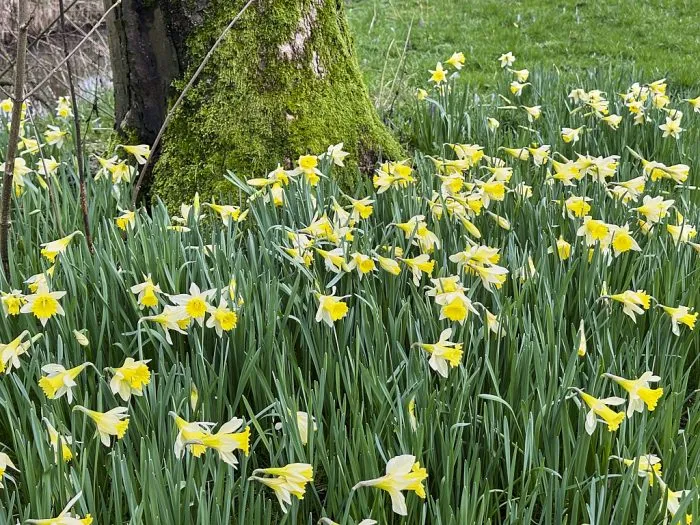
Narcissus pseudonarcissus var. lobularis
More delicate indeed are the different forms of Narcissus bulbocodium, the so-called petticoat daffodils – charming miniatures, that are ideal for naturalising in grass. Also, I grow Narcissus pseudonarcissus var. lobularis that peaks throughout next month, but is always in flower towards the end of February. It is a perfect miniature with bold yellow and white flowers that increases easily by self-sown seed and eventually develop into bold pools of fresh colour in the garden landscape.
This blog post is from – 60 YEARS A GARDENER, a new eBook from Michael King relating his experience and gardening knowledge gained over more than 60 years.
Each month of the year is celebrated in text and photographs taken in his own and other gardens from around the world over the last 25 years.
60 YEARS A GARDENER – € 9.99