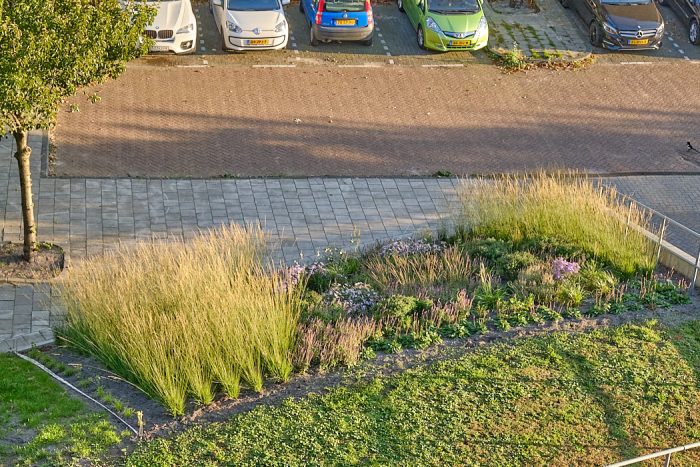
Following on from my previous post on using molinia grasses in a perennial meadow, this time I will be using one of the lower growing forms of Molinia caerulea subsp. caerulea. These Purple Moor Grasses are divided into two groups: the taller reaching more than 2 meters when in flower and the lower group that is less than 1.5 meters with some being really compact and stiffly upright.
This scheme complements the one previously discussed as it will be planted on the adjacent bank of the same large pond; the two schemes being separated by a tall, wide waterfall. Here is an example of how different perennial meadow schemes can be organised to bring both variety and continuity to a garden space. The earlier scheme used the tall grasses as a bold dominant theme, but here we substitute the small growing subspecies caerulea and plant it far wider apart allowing space for wide, bold drifts of white flowered persicarias. White flowered persicarias are far more delicate and whispy than the orange pink flowered cultivar used in the adjacent scheme, but they continue the theme. Geraniums and clovers are used in both schemes at similar densities while for a different summer theme I have introduced the pale-yellow, small flowered daylily – ‘Corky’.
1 x 2 Molinia caerulea subsp. caerulea ‘Heidebraut’
3 x 1 Persicaria amplexicaulis ‘Alba’
1 x 2 Geranium ‘Anne Thomson’
1 x 2 Trifolium ochroleucum
2 x 1 Hemerocallis ‘Corky’
To understand how these plant recipes work please look at the Meadows 101 section of this site and my Introduction to Perennial Meadows eBook. Put simply, when I write 1 x 1 I am suggesting one theme plant per square meter/yard, 2 x 1 means two plants per square meter/yard and 1 x 2 means one plant per every two square meters/yards.
My perennial meadows also include the so-called complementary plants to both extend their season of interest and prevent them from becoming monotonous. To understand this aspect of their design take a look at some earlier postings now included in the Meadows 101 section on complementary planting.
Next week I will be moving onto a different species of ornamental grass and devising a planting scheme around it.