Following on from my previous post about Floriade 2012 I thought I would share some of the planting ideas that I encountered there. As I commented earlier, such a season long show allows designers to experiment with different uses of plants, but unlike a garden show such as the Chelsea Flower Show these plantings have to work for at least one full growing season.

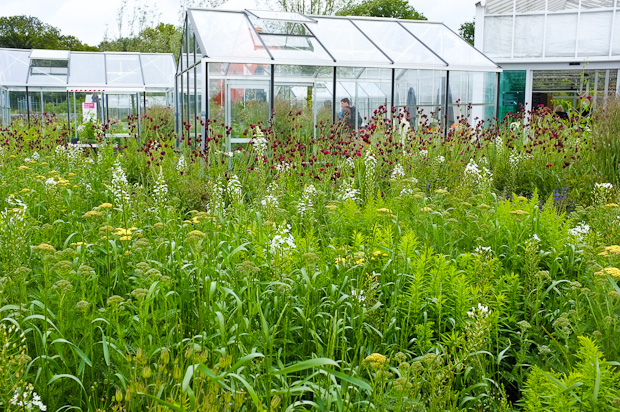
This was an area of planting around the terrace where I stopped to eat my lunch. My feeling is that it is untidy and lacking in structure with too many plants of a similar height. I had noted this area during my first visit in April and it looked promising, but green and not particularly attractive. I can imagine that in late summer when the flowering plants have turned to seed and the many clumps of Calamagrostis x acuitflora that occur throughout turn stiff and golden the meadow like scheme may look magical, but this is too long to wait.

How could this planting have been better? I think the plants surrounding the tall grasses should have been selected to form a lower more solid layer; I am thinking broad leaved Nepeta subsissilis or Phlomis russeliana. As I see it at the moment there are too many whispy and tall grasses pushed in together, but some will find this informality attractive.

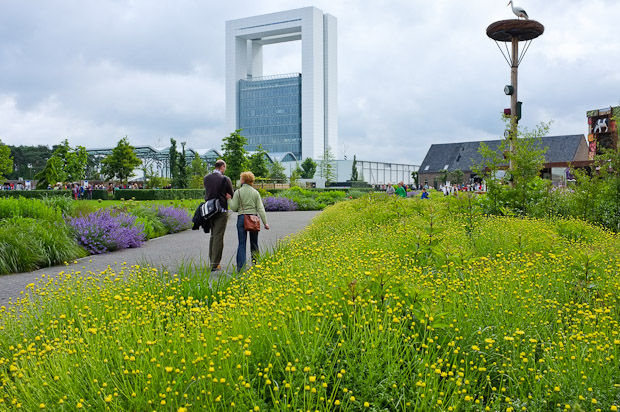
In the Green Engine zone I liked the silver shrub borders that were used to edge and organise the space around the dominating Villa Flora exhibition hall. The use of concrete sleepers and not natural rocks to bring some solid structure worked well. In Holland rock is only to be found in one tiny region in the south of the country, traditionally buildings are made from bricks and tiles. For this reason, I always find the use of rocks and boulders in Dutch gardens as inappropriate. These man made elements added structure and pattern to these planting areas.

One plant that stood out was tall wiry Cephalaria gigantea, the giant yellow flowered scabious. I grew it years ago and thought it ineffective and whispy, but here as a fountain above its neighbours it was most effective. So next week I will be trying it again in my garden behind two perennial meadows dominated by low-growing molinia grasses. In early summer they do look rather flat and ineffective, the placing of this scabious behind might just do the trick.

Another perennial plant used amongst these silver shrub borders was Epilobium angustifolium ‘Stahl Rose’ the garden form of willowherb. Now it looked fantastic in these gravel topped borders and I am sure some gardeners will be encouraged to introduce it into their own gardens. When I did, it took me three years to get rid of it; even on my heavy clay soil it charged around like a herd of buffalo. However, here, for a one-season flower show it worked very well!

I commented upon the large perennial borders in the Education and Innovation zone of the show in my previous post. Like mini border schemes, patches of planting are stamped into these huge borders one next to the other and repeated at intervals along their length.

Individually the patches were fine but their repetition gave the impression of the plant growing well in some areas on not in others. I have seen photographs of these borders following thier first year’s growth at the end of last summer and the effect looked chaotic. Perhaps by the end of their second season things will be working better, but I must reserve judgement.

I commented positively about the wide drifts of ornamental grasses surrounding rivers of heathers during my first April visit. Now in mid June they still looked very good and whilst I might hate them when eventually the heathers flower, this is an idea I would like to try out one day.

Another interesting planting detail here was the association of adjacent blocks of deschampsia grasses. These different cultivars are all slightly different in height and flower colour and so together they created a subtle modulated scheme.

The final planting idea that I found whilst wandering around was the combination of Phlomis russeliana, course and upright, and the frothy white (daisy) flowered Kalimeris incisa. These are both plants for open sunny sites with an incredibly long season. It was a simple but inspired association.

So in conclusion a show such as Floriade 2012 is a marvelous laboritory in which to try out new ideas. If they don’t fully work we all can learn, and anyway it is only for one summer. Each of my visits so far has made me think, tought me things and been thoroughly enjoyable. If you too get the chance be sure to pay it a visit; if you don’t you will have to wait ten more years!